
Tips When Taking Photos for a Magazine

There’s simply nothing quite like seeing your name and pictures published for the first time in a magazine or even manga. Do you feel ready to take the plunge and start working as a magazine photographer?

Here are some suggestions to get you there.

1. Become a magazine photographer: Choose a niche to make yourself more distinctive
Some people have a tendency to believe that portfolios containing a variety of photos are popular with magazines. It is just untrue.
Editors value uniformity. Keep your attention on what you do well and stick to it.
If you enjoy shooting landscapes or cuisine, don’t be concerned about not getting jobs. Although there are many freelance and professional photographers, it is preferable to be the greatest in your industry as opposed to being average in a certain specialty.

3. What Tools Should You Purchase?
Professional equipment is not necessary when you are just getting started. It doesn’t imply you can just use your phone or a small camera and get away with it either.
DSLRs or mirrorless cameras are your best options. They enable Manual Mode and lens switching. Purchasing the entry-level model is OK.
Although it may be inexpensive, it offers everything you want to generate work that is worthy of publication in a magazine.

4. Portfolio Development

The following stage is to build a respectable portfolio. Even if you haven’t conducted any actual photo sessions yet, it doesn’t matter. You must nevertheless maintain a professional appearance throughout.
Choose a few pictures that you think are the finest. Even if you can’t explain why a certain image appears odd, don’t use it if you have any doubts about it.
For your initial portfolio, try to include at least 10 pictures. That’s about the ideal number of images to allow editors to decide whether you would be a good match for the publication.

5. Utilize Instagram to broaden your audience potential
Think about social media as a portfolio addition. Everyone who tries to search you up online will eventually come across your Instagram.
You may as well make sure that the photographs you upload on your feed are topnotch as well.
Instagram is a frequent place where photographers are found. Thus, you have to advertise your own work on the site.

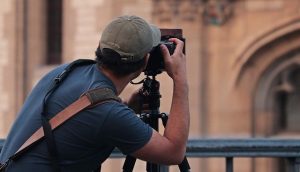
Tips When Taking Pictures for Your Gaming Profile

1 Smile

Smiling is among the most underutilized features you may include in your profile photo for your account. You may display your individuality and friendliness by grinning. People do not want to follow someone who appears furious, despite the fact that refusing to grin may seem cool.

2. Employ A Special Background

Your profile picture’s backdrop conveys a lot about who you are and what you stand for. A professionally created background may introduce you to your audience. While it should reflect your personality, make sure it is also well-organized so that your audience is not deterred by the background noise.

3. Show Your Face

Your face must be visible in your profile photo, which is one of the most important things to complete. It might seem clear, but it’s not. Many people choose their most memorable experience as their profile image. People are curious about you and want to visit you. A photo of your back is not what they desire.

4. Employ A Current Image

Use a current photo of yourself as another essential step. People do not want to see a photo of you as a youngster; instead, they want to know how you currently appear. A current photo of you may be used to give people an impression of who you are and what you stand for. If you maintain a fresh, updated profile image, they will be more inclined to follow you.

5. Utilize Proper Lighting

For your profile photo, be sure to pick the finest lighting you can. If you can take your photo in the middle of the day when the sun is shining the brightest, you may obtain the finest profile image since natural light is always preferable. Avoid using lights as your lighting source.

6. Use the ideal focal length.

Your facial characteristics can be made perfect and properly accentuated if you choose an optimum focus length. Nobody likes to seem out of proportion in their photos, and choosing the right focus length may help avoid this.

Capturing Amazing and Instagram Worthy Photos!

To amateur photographers, catching a great photo can look easy: just aim and shoot. But anyone who’s attempted to learn how to capture expert photos knows that it does not stop there.

From picking the best subject and establishing up a great combination to discovering the best light, it demands a lot of thought to take a great photo.

If you want to take your photography to a higher level, below are some suggestions to help you study how to take great photos. Once you get a hang of these essential pro methods, it should greatly advance your outputs.

The most enjoyable part about understanding how to take high-quality photos? It leads to new possibilities

Master the Essentials of Composition

Choose a Powerful Focal Spot

The focal point of an image is the central point of excitement. It could be anything from a plant, to a structure, to a person (or their mouth, eyes, nose), or someone you see working, perhaps in a building or repiping. Looking for a great focal point is one of the essential steps of how to capture expert images. So when you’re mapping out or fixing up a shot, you must stop and question yourself, “What do I want observers to concentrate on?”

Utilize Leading Lines

These are line shapes in your shot that can help the observer’s eyes to only focus on the subject. They can be anything that produces a line in your photos, such as roads, walls, structures, large hallways, trees, or obscurations.

The secret is using them to get a spectator’s attention where you prefer it to go. That can incorporate having their eyes straight to your subject, or directing them a kind of optical journey in your organization.

Frame Your Shot

Framing is another method that is truly helpful in taking professional photos. It includes looking for something that can act as a normal frame for your composition and then capturing so your focal is inside it. A few examples of these include a doorway, an entrance, some foliage, or a crack in a wall. This kind of framing can help guide the viewer’s awareness to your main point.